
|
BLUE BLOG |
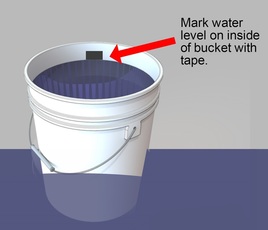
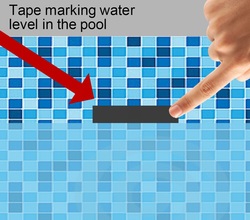
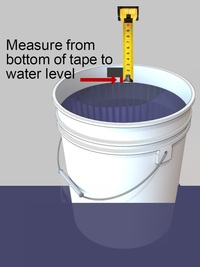
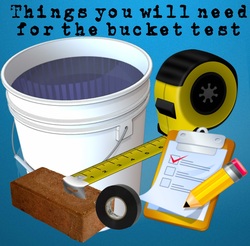 "I think my pool is leaking" is a very common call for us and apparently a looming question on many pool owners' minds. If you suspect there is undue water loss from your pool, NOW is the best time to find out for sure. Even a small leak in any pool, if undetected or ignored, over time has the potential to cause major settlement and structural damage to any pool and can drain your budget as well as your pool. Finding and repairing a leak or leaks in any pool involves a bit of detective work and is best performed NOW while the pool is still open, clean, running, reasonably warm, and actively leaking. You do not want to wait until the pool is closed and covered and the weather is cold to find that your pool is draining slowly under the pool cover. ALL pools lose water while they are open, even if they are not leaking. Evaporation accounts for a great deal of water loss on a daily basis, as does splash out, backwashing of filters, and the like. How can we tell if our pool is only loosing water due to evaporation or if other factors are at play? I wish I could tell you exactly how much water your pool would lose to evaporation, but evaporation loss is dependent on a number of variables such as water temperature, air temperature, surface area of the pool, sunny or shady location, windy or protected location, relative humidity and more. Fortunately, there is a simple test YOU can perform to tell for sure whether your pool is losing water due to normal conditions only or if you truly do have a leak in the pool. Referred to as the "bucket test", this is the first step we ask anyone to perform prior to beginning any diagnosis for leaks in the pool. The bucket test tells conclusively if any pool is leaking or not and if so, gives us the information to be able to tell pretty exactly how much water is leaving the pool due to leakage and is important information to have in hand if we come to check your pool. To properly perform the bucket test, you will need
If you utilize a solar blanket on your pool, it should be removed and left off during this test. The bucket should be filled with pool water and then needs to be placed or suspended in the pool so the water in the bucket is surrounded by the pool water and thus should stay the same temperature as the pool. The bucket can be placed on the pool steps or love seat (putting a brick in the bottom helps keep it from floating off the steps), lashed to a ladder, hung from a diving board or tied off in a corner of the pool.
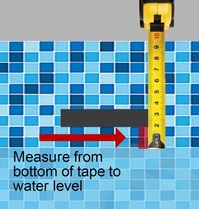
If the distance from tape to water is the same in both pool and bucket, you DO NOT have a leak in your pool and the water loss is due to normal evaporation. If the distance from tape to water level is greater in the pool than in the bucket, subtract the bucket measurement from the pool measurement and the difference is how much water is actually leaking from the pool. If the distance from the tape to water level is greater in the bucket than in the pool, something probably went wrong (bucket and pool were not the same temperature, the bucket leaks, etc.) and you should try the test again or call for advice.
If you determine through this simple test that your pool is indeed losing more water than simply from evaporation, give us a call NOW while the weather is still warm and the pool is open. Armed with the results of this test, we can begin the process of finding and eliminating leaks from equipment, piping, and pool shell sources and help prevent further damage to your pool.
3 Comments
 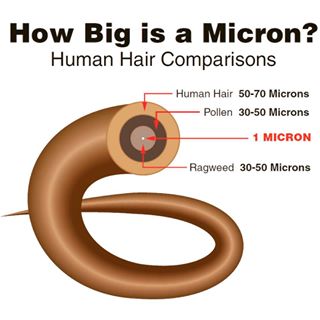 “Which filter choice is right for me and my pool?” is a common question often asked of me to which there is really no definitive answer. The 3 leading choices available for pools today are DE (or Diatomaceous Earth), Cartridge, and Sand filters. There is no “perfect” filter choice for any pool - all have their strong points and all also have drawbacks. It is my hope that this general discussion of filter types listing advantages and disadvantages will help you make the right choice for your individual situation. The operative terms in pool filtration are “EFFICIENCY” and “CAPACITY”. Efficiency refers to how small a particle of dirt, measured in microns, a filter is capable of trapping and is the most important term in determining water clarity. To help put this into perspective, particles start to become visible to the naked eye in the 35 to 100 micron range. Examples of particles in this range include some pollens (30-50 microns), human hair (50-70 microns or so in diameter), beach sand (around 100 microns in size). It is important that any pool filter be more efficient than this, as most bacteria, single cell algae and the like are much smaller than 35 microns. The more efficient a filter is, the clearer it can make your pool water. Capacity refers to how much dirt afilter can hold before it needs service, backwashing or cleaning. Capacity is typically measured in “square feet of surface area” for pool filters. The greater the capacity of a filter, the longer it can run between cleanings. The filter pressure gauge is used with all filters to determine when it is time to clean the filter. It is always important to know the “clean” pressure of your filter system. As the filter catches dirt, it becomes harder for water to flow through the filter and the pressure on the gauge begins to rise. 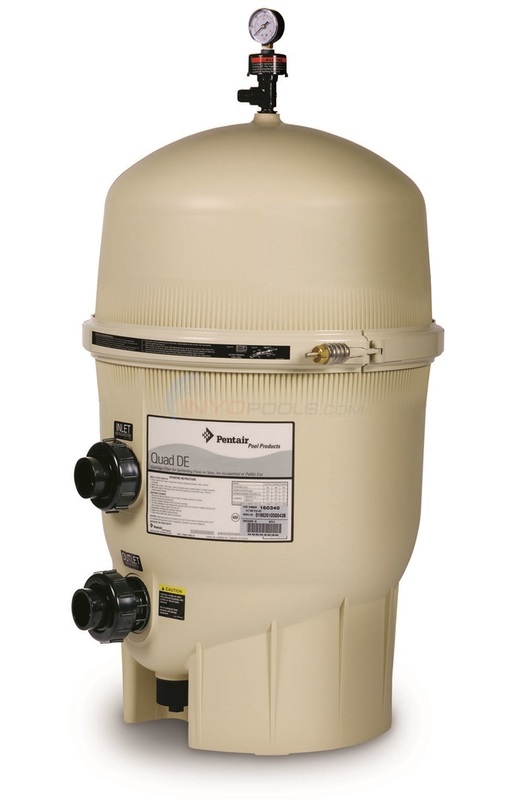 DE or Diatomaceous Earth filters have long been touted as the “best” type of filter for a swimming pool. Diatomaceous Earth is a fine white powder, somewhat similar to sand but much smaller in size, that is used in all DE filters to catch the dirt from your pool water. They are “best” in terms of efficiency by far compared to the other choices of filtration available for your pool. Regardless of manufacturer or design, all DE filters have an efficiency rating of 3-5 microns which is truly microscopic in size. A typical DE pool filter has some sort of fabric covered hollow elements inside. The fabric is woven tightly enough so that water can pass through to the inside, but Diatomaceous Earth cannot. DE is fed through the pool skimmer while the pump is running and flows into the filter, coating the fabric element evenly with a layer of DE. Water flows through the DE, through the fabric, and is collected clean inside the elements and returned to the swimming pool. Diatomaceous earth filters for residential pools are cleaned by backwashing. Backwashing involves moving a valve or valves to reverse flow through the filter. Water is sent backwards to the inside of the elements, flushing out the dirt the filter has caught and also the used DE coating, and sending them out of the system to waste. Once cleaned, valves are changed to restore flow in the proper direction, and a new coating of DE is fed through the skimmer into the filter, “re-charging” it with the proper amount of DE. While DE filters are truly the best in terms of efficiency, they can be a little unforgiving at times to operate. Simply put, nothing much gets through a properly functioning DE filter and they can clog quite rapidly under dirty water conditions. As such, they require more frequent monitoring and regular backwashing and recharging with DE to keep them running at peak efficiency. A Pentair FNS PLUS DE filter is the right choice for anyone who wants the clearest possible water and is prepared to spend some regular time on simple filter maintenance.  Advantages of owning a Diatomaceous Earth (DE) Filter: * Most efficient of all filter types available for pools (can catch the smallest particles of debris down to 3 microns). This is true of all DE filters regardless of style due to the fact that it is the DE that catches the dirt from the pool. * Relatively large surface area compared to some other types of filters. * Modern style of grid filters we sell are easy to take apart, service and clean. *Modern style of grid filters we sell come with a multiport 6- position control valve for service flexibility.  Disadvantages of owning a Diatomaceous Earth (DE) Filter: *Need to learn proper backwashing technique and backwash regularly to keep filter running at peak efficiency. *Because filter is so efficient, it can be unforgiving if you are not keeping up with the other aspects of pool care, particularly water sanitization. *Need to buy, use, store DE and dispose of spent DE after backwashing. Cartridge filters have been available for many years but are making a resurgence in popularity due to favorable changes in engineering and design. A typical swimming pool cartridge filter uses a set of pleated cartridges to catch the dirt from your pool water. While not as efficient as a DE filter, cartridge filters do pretty well and catch particles in the 8-30 micron range. This small sacrifice in efficiency is made up for in greatly increased capacity. Cartridge filters typically have a capacity about 9 times larger than a DE filter with a similar tank size. This translates into a tremendous savings in time spent on pool maintenance. With all other factors being equal, a cartridge filter is cleaned once for about every 9 times a DE filter would require maintenance. While not particularly recommended, it is possible for a properly sized cartridge filter to run an entire swimming season without much attention or cleaning. Cartridge filters can also save water and chemicals in your pool, as there is no backwashing out of any pool water to clean a cartridge filter. When the filter gets dirty (as indicated by pressure rise on the gauge), the cartridges are removed from the filter, hosed off with a garden hose, and replaced in the tank again when clean. The old adage “time is money” applies to cartridge filtration, however. Since we are relying on the large capacity of this style of filter to save us time on regular maintenance, there can be a higher cost of ownership of a cartridge filter. The elements typically have a useful life span of 2-5 years, depending on conditions and care, before they need to be replaced. A Pentair CLEAN AND CLEAR PLUS cartridge filter is the best choice for someone who doesn’t mind spending a little more money to save a lot of time on in season pool maintenance.  Advantages of owning a Cartridge Filter: *Great time save! Super large surface area (capacity) relative to filter tank size gives longest filter cycle before filter requires cleaning. Can be sized to run the whole season with minimal cleaning or attention. *Still reasonably efficient (6-8 micron capability) *Great water savings. Filter requires no backwashing so water and chemicals stay in the pool. *Modern style of cartridge filter we sell are easy to take apart and clean.  Disadvantages of owning a Cartridge Filter: *When it is time to clean the filter, it must be physically disassembled and the cartridges rinsed off with a hose. *Higher cost of ownership than other filter types. Because we are using this filter to save our time, there is a cost in replacing the filter elements every 3-5 years on average. (time vs. money) Sand filters have been around as long as swimming pools have. With a typical modern sand filter, pool water is forced through a bed of sand, which catches the dirt, and then returned to the swimming pool. Sand filters are cleaned by backwashing which reverses flow through the sand bed and flushes captured dirt out of the sand and to waste. The sand stays in the filter and is reused over and over again. Sand filters score lowest in both efficiency (25-80 microns particle size) and capacity (the capacity of a sand filter is typically the surface area of the top of the sand bed), but are still in use today because they are simple and low cost to understand and operate. Because of their relatively small capacity compared to other choices of filter, sand filters require frequent backwashing and waste the most water and pool chemicals in the process. Sand filters can help keep a clean pool clean and presentable, but due to their low efficiency and small capacity, can rather quickly show their limitations under extreme circumstances. For those who prefer the time tested simplicity of sand, Pentair TRITON II sand filters are among the finest available.
Now that you know the basics, if you still have any questions regarding the proper choice and recommended size of filter for your pool, please give me a call or email. It is our job to make sure your pool is as easy and trouble free as possible to care for. |
 RSS Feed